

Scrubber Dryer at the Fire Brigade
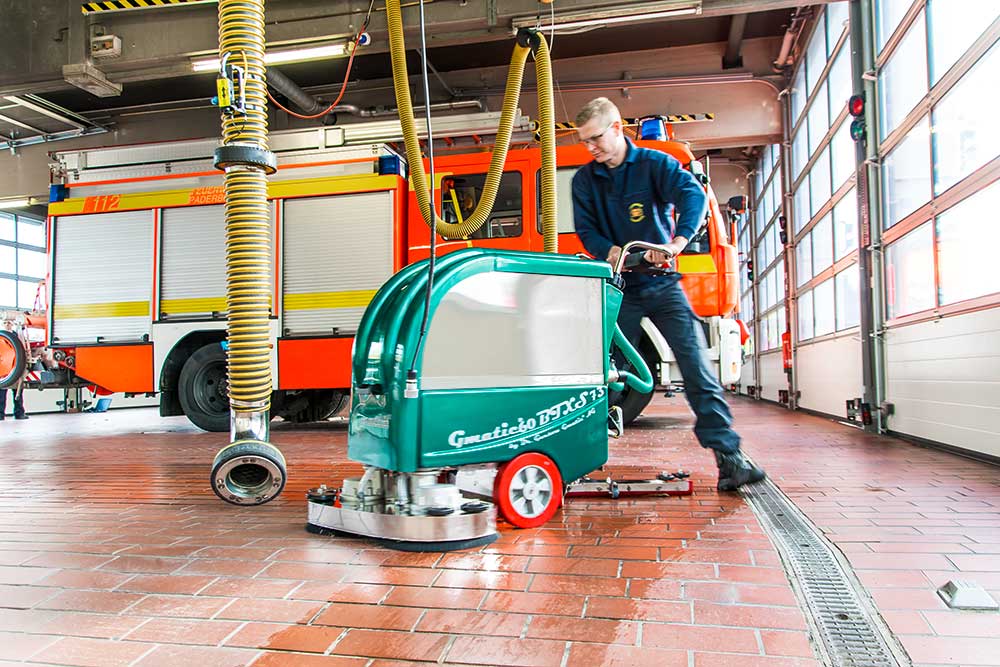 When it comes to procuring vehicles and equipment, selecting clothing and choosing extinguishing agents, fire brigades put safety and quality first. Budgets and expenditure items have to be subordinate to this principle. The floor cleaning of fire stations does not receive the same appreciation. Those responsible, employees and volunteer members of the fire brigade usually find this out at an inconvenient moment, when the cleaning work planned in advance turns into laborious manual work for lack of a working scrubber dryer. The cleaning concept of Dr. Gansow Gmatic AG offers a reliable solution.
The Challenge for Floor Cleaning
On 20 July 2017, the Hessian Higher Administrative Court (VGH), file no. 5A 911/16, upheld the claim of an employer of a volunteer member of a voluntary fire brigade to reimbursement of continued payment of wages during illness following an accident during work in and at the fire station. The condition of the floor is assigned the greatest influence on slip resistance, followed by footwear and cleaning. Substances that promote sliding, such as greases, emulsions, brake fluids or dust, can almost completely cancel out the friction between floor covering and shoe sole, even on rough surfaces. A consistently applied cleaning plan would contribute significantly to “defusing” the situation. And because incorrectly dosed or unsuitable cleaning agents can also reduce slip resistance, the cleaning plan should specify the cleaning agent to be used together with its dosage. That is exactly the competence of the Dr. Gansow method.
The Scrubber Dryer in Operation
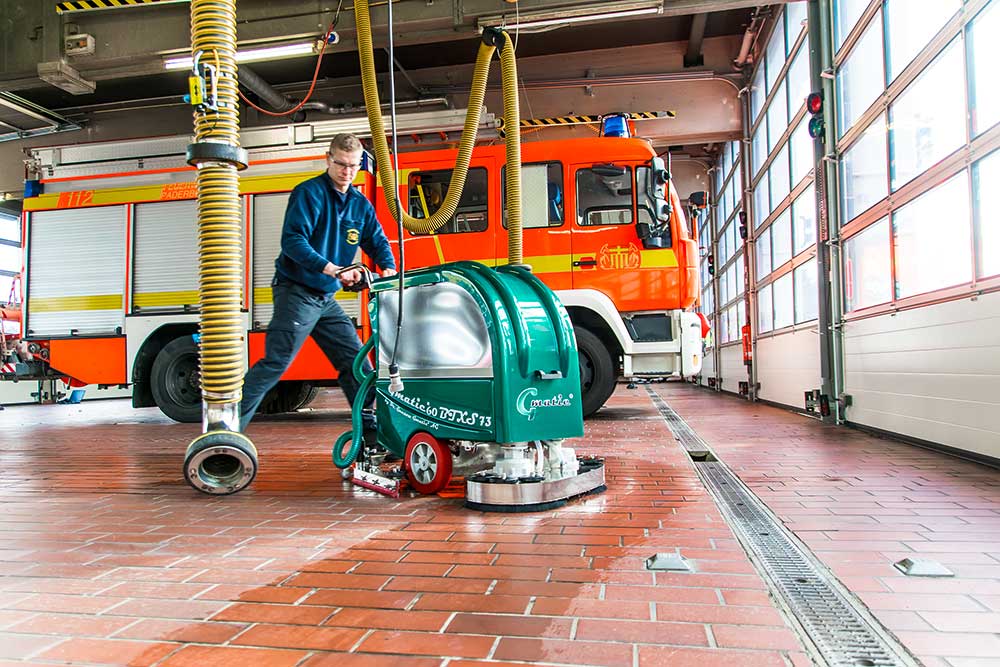
A contemporary cleaning plan for a fire station relies on mechanical components. For the floor cleaning machines in use, high performance and stainless steel materials have not yet become common: capillary polyethylene tanks, brush heads and squeegees made of untreated aluminium still determine budget-driven decisions. Here Dr. Gansow sets a counterpoint with the Gmatic scrubber dryers, built entirely of galvanically polished stainless steel with food-grade acrylic decorative parts (PMMA), thus ensuring even the consistently safe implementation of HACCP EU 852/2004 and the relevant IFS standards.
The cleaning performance is based on extreme scrubbing and dry suction with the electrochemical Gmatic cleaning agents, which already call for the resistance of the electropolished material DIN 1.4301.
Tools and Cleaning Agents
The R12 to R14 floor coverings in workshops and production areas, made of fine stoneware or quartz-sanded epoxy resin, create an intense grip on trodden-in and dried-on dirt and cleaning agent residues. In addition, the ASR standard leaves no scope for choosing smoother surface profiles. Here the basic cleaner Gmatic Ultra 301PSKT, with its alkaline and electrochemical formulation, has become the standard when capillary floor restoration is also required. After the Gmatic scrubber dryer (usually the 60BTXS73), the floor surface is properly matt and the shoe soles can be made to “squeak”. With no dirt residues at all – even in joints – “total hygiene” is built into the process. The scrubbing brushes with balanced PU drive plate are made of PA6.6 with abrasive silicon carbide in SC46 (anthracite) or SC120 (green), the squeegee blade of PU Primothan.
Innovative Battery Pack
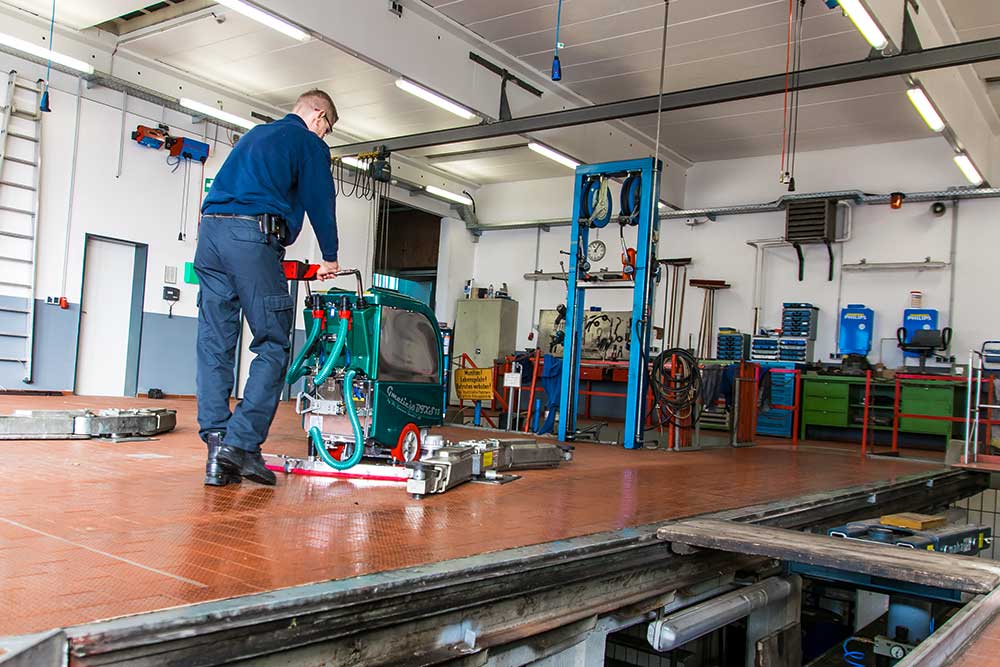 A cleaning vehicle not only has to be available for as much of the working day as possible, but ideally also constantly available. The battery technology used in Rotan cleaning vehicles makes this possible. The installed NexSys® block batteries can supply sufficient electrical energy for up to 7 hours. Charging, on the other hand, takes only 4.5 hours. Partial charging is welcome: the charging process can be interrupted at any time and resumed later without damaging the battery. The service life of these special AGM batteries is 40% longer than that of conventional GEL batteries – always at the same depth of discharge (DoD).
Gmatic Cleaning Concept
Today a fire station is a “precision operation” with high legal requirements: the QA department that accompanies all processes has to test the currently available state of the art in technology and chemistry in day-to-day operation, validate it and ultimately implement it. It has a say in all decisions that influence the processes.
- Increased slip resistance of the floor
- Minimised risk of slipping and falling
- Reduced accident damage to fixed and current assets
- Significant reduction of subsequent re-soiling
Service & Distribution
Do you have questions about our products or do you need help? We will be happy to assist you.