


Veterans of the Cleaning Industry
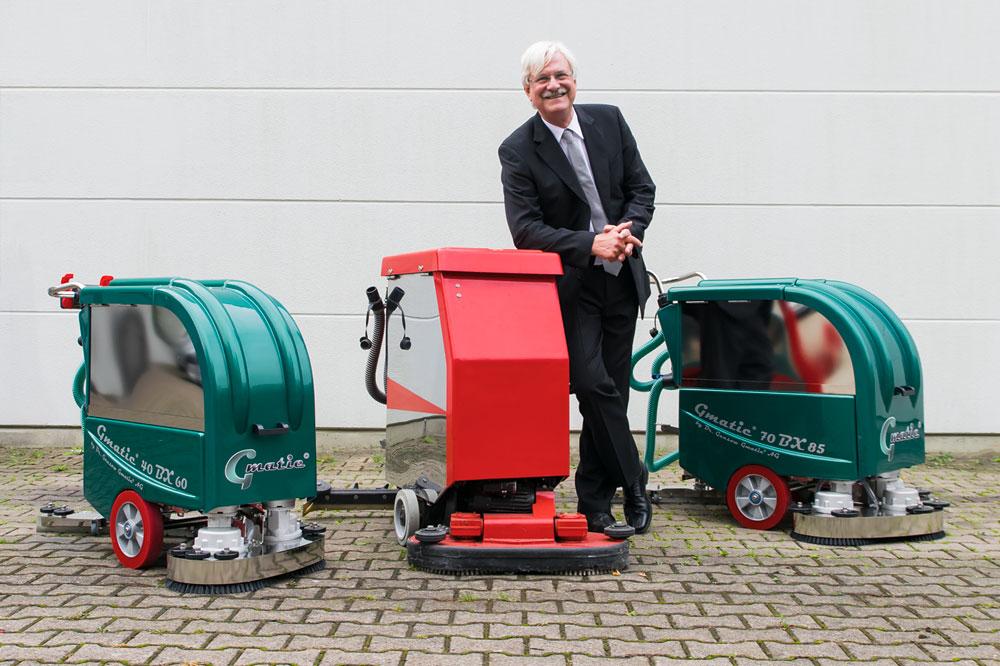 “Preventive maintenance – is this strategy worthwhile or not?” – the deeper subject of his doctoral thesis has accompanied Dr. Peter Gansow throughout his life. While still studying at TU Berlin, he took on responsibility as general agent of his parents' company in Berlin and, not long afterwards, at the age of 25, ran the family business with 120 employees on behalf of his ill father Robert Gansow. A “life on a timeline”, as he tells ReinigungsMarkt publisher Reinhard Knittler, Knittler Medien managing director Daniel Knittler and editor Volker Beck.
Dr. Peter Gansow was born in 1951 in Wittenberge on the Elbe (Brandenburg), into a family in which entrepreneurship was part of the DNA. Before the Second World War, his maternal grandfather ran a confectionery wholesale business in Wittenberge (Brandenburg) and during the war was responsible for the local distribution of food. Immediately after the Second World War, Dr. Peter Gansow's parents ran an ironmongery there. After the suppression of the uprising of 17 June 1953, the Robert Gansow family succeeded in getting to the West with an official exit permit.
First stop: Hagen − There his father sold refrigerated display units at the Essen branch of Brown, Boveri & Cie., today part of the ABB group. His mother, who had studied business administration at Humboldt University, suggested taking the plunge into self-employment once more. “A tradition of self-employment existed in both parents' families,” Dr. Gansow recalls.
In 1964 the family had by chance become aware of 3- and 4-disc suction polishing machines from ELDO in Italy, which were sold by mailings to doctors' surgeries, building cleaners and other customers. This also led to contact with Willi Groppel, state guild master from Hagen, who was guild master of the Südwestfalen guild from 1963 to 1975. Groppel, Dr. Gansow explains, made his father Robert Gansow aware of the fact that at that time there were no suitable floor cleaning machines for building cleaners. “My father began to develop the first European so-called ‘cable automatic machine’ together with an engineering student − at that time a real automation process.”
The machines, christened “Taifun” and fitted with stainless steel tanks, were the basis for the development of the family business. This also had an impact on Peter Gansow's life. “At weekends, the machines that had been ordered were assembled in the children's room. Everyone in our family had their task. That was a matter of course.”
Studies and Start of Career
At 16 he met his future wife. “Just before turning 18, I registered my move to Berlin, to my mother's former student flat in Charlottenburg,” reports Dr. Gansow. He regretted that conscription did not apply in Berlin − with a big wink! During this time six garages were built in Hagen, without partition walls − the first production site. “That was in the middle of a residential area, but the building authority went along with it,” he stresses. Electrical production was outsourced to the private homes of two employees. In 1969 he went to Berlin to study, his future wife to Münster. The relationship lasted.
He earned his living as Gansow's general agent for West Berlin. “I sold my father's machines and had a lot to do with EDEKA, ALDI and service providers.” Even the Iranian Air Force was among the customers of the Gansow company in the days of the Shah. An Iranian officer, trained in England, who was visiting the then new plant in Bergkamen, helped him to set the intake manifold injection of his damson-red Triumph TR6Pi of the time optimally.
Doctorate and Practice
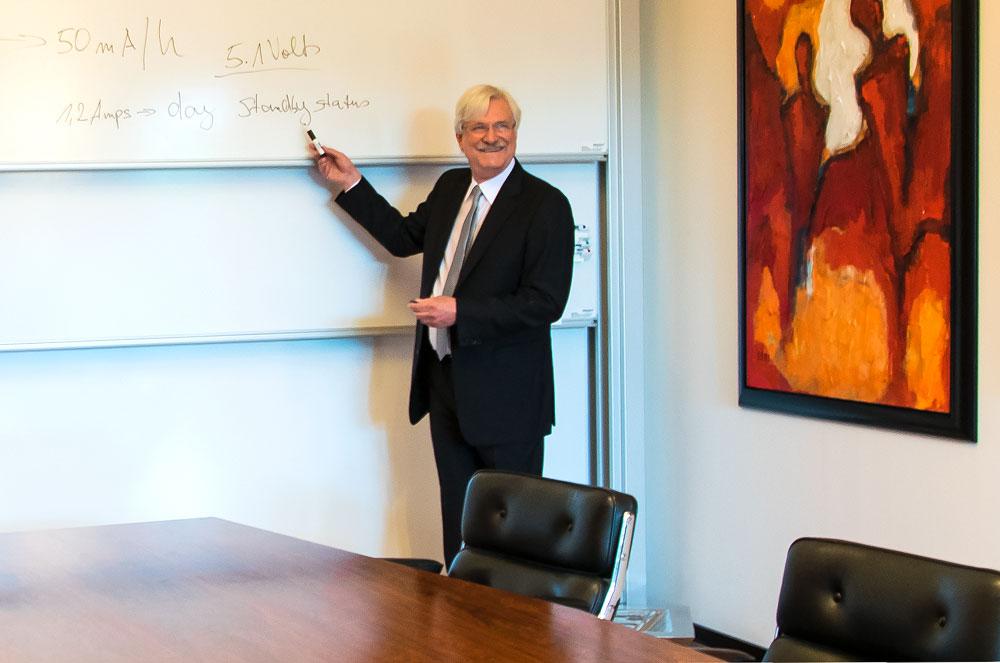
It was always clear to Peter Gansow that he would join the family company. “My father always said, however: ‘Boy, if you have the chance to do a doctorate, do it!’” “My doctoral thesis was interdisciplinary, commercial and technical,” he recalls. “The time as a doctoral student was interwoven with first responsibility in the job.” “From 1973 on, the doctoral thesis shaped the course of my life in terms of content,” Dr. Gansow explains. Its subject was “Components of a production function for the cleaning of non-textile floor coverings with a two-phase floor cleaning system”, with the subtitle “Economic-technical investigation into the consumption of relevant production factors, in particular operating equipment elements”, and it was closely linked to what was then the new theory of the production function type B by Prof. Dr. Erich Gutenberg and the production function type C by Prof. Dr. Edmund Heinen. Type B extended Wassily Leontief's A function (roughly: input times factor equals output with constant returns to scale) by the intensity of use. A motor operated in its optimum torque range means minimum energy consumption and the lowest component wear per unit of production. Type C makes the view dynamic by extending it beyond the moment over a defined time axis. In his doctorate to Dr. rer. pol., Dr. Gansow developed this approach further, to the question of the usefulness of preventive maintenance as a strategy for the future. “I did it with our machines, as there were serious problems in getting the data sets of other manufacturers.”
In 1976, when Peter Gansow was in the middle of his doctorate, his father Robert suffered a heart attack, which he survived until 1998. In his mid-twenties he suddenly found himself at the head of a company with 120 employees. “At 25 you are not yet settled, but the challenges and the calibre of business partners make you grow up quickly.” Altogether, Dr. Gansow's life is not a life in fixed stages, but rather a fluid transition. “That was always the case with me. I could never say, right, that stage is done, it was always multitasking. You were a little ‘Napoleon’ who constantly had to organise himself: a life on a timeline.” His doctorate helped the young Dr. Gansow to run his parents' company on behalf of his father during his convalescence. “The title opened doors for me at a young age, because that was something people in the cleaning industry weren't used to at the time.”
In the course of his doctorate it also became apparent that for a design based on modern direct drives, without the chains or V-belts usual at the time, preventive mechanical maintenance is not indicated, because “with proper gear design and sealing, the ball bearings are the limiting element. That is a linear wear process stretching over long periods, which is hardly likely to accelerate unpredictably in future. If we are talking about 15,000 hours that a gearbox lasts, then in the cleaning industry that is considerably more than a decade that a machine can last.”
A look back, if I may: “Competitors had chain or belt drives in the travel drives and brush heads, which were tensioned. Depending on the slip, the travel speed then resulted. With their mechanical wear pattern, these machines were predestined for preventive maintenance.”
“If I spend just 10 percent more on a drive when purchasing, I get 30 to 40 percent longer service life and thus more quality – that is my experience. My father, however, rather took the position of cheap purchasing, but then accepted the point in view of the markedly improved running times of the drives and controls.” These findings of his doctorate were consistently applied in the design and production of Gansow machines from 1976 onwards. He was thus able to show that, at low additional cost, the ball bearings can be dimensioned considerably more robustly, achieving extreme longevity. “If I go one notch up on the carbon brushes and the commutator design in the DC motors, I get into a service-life range that is insane,” Dr. Gansow explains. “Today we only have regulated drives, which are even less prone to failure, because the system controllers limit and reduce the energy supply when current demand rises, through software design and parameterisation.”
Company Growth
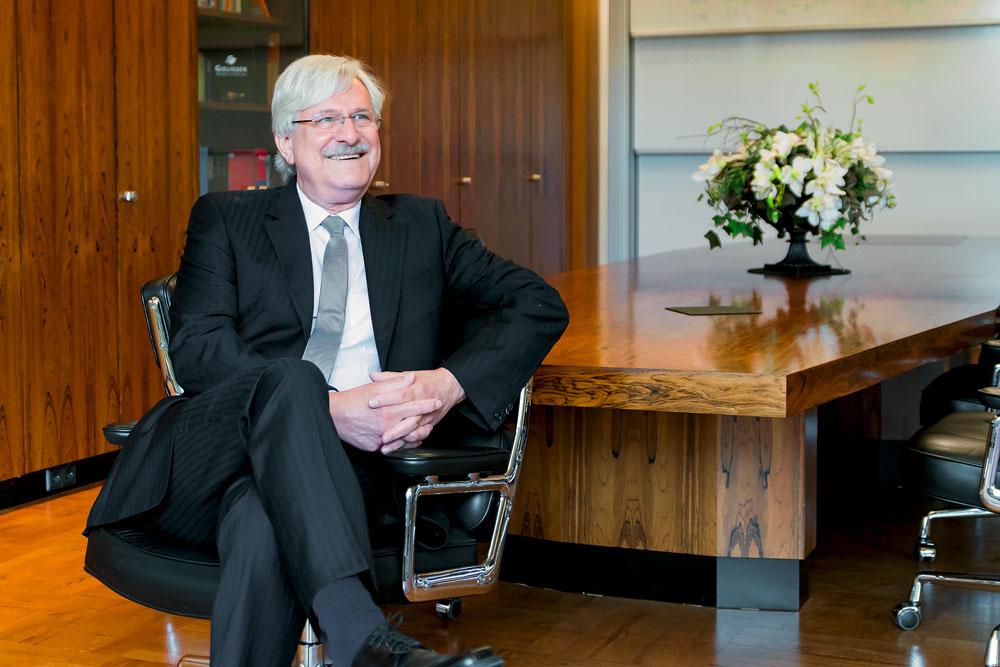
In 1971 the first production hall of 1,300 square metres was built in Bergkamen; by 1996 the Bergkamen site had been extended to a total of 8,500 square metres for administration, storage and the production of scrubber dryers and scrubber vehicles as well as hydraulic paper presses.
From 1997, vacuum sweepers and a line of lower-priced scrubber dryers were manufactured on 6,000 square metres in Fombio (east of Milan). The Gansow Group employed 420 people, including around 200 employees providing on-site service at customers' premises. The Gansow Group was characterised by a high degree of vertical integration. Surface technology, metalworking and plastics technology − all of this was done in-house. Growth was organic and steady. The Staehle family (columbus) was among the large sales partners at the beginning. Another was FMC in Zug (CH) with the Wayne label, at that time the first overhead-throw machine in the vacuum sweeper industry. “During this time I was able to build up a great many skills, for example also that of using international contract law in negotiations.” FMC's managing director Oberholzer left his mark on Dr. Gansow. “His motto: live and let live, and not squeeze the last drop out of business partners, that shaped me. Being open, honest and upright was always important to me.”
Insolvency and New Beginning
At its peak, his former company employed a good 200 people in sales alone across Europe; in 26 German branches an average of 3 employees were employed (commercial and sales), and 70 fitters looked after customers throughout Germany. 6,000 scrubber dryers and 1,800 vacuum sweepers − half of them large machines − were manufactured per year. “Things were really going well,” recalls Dr. Gansow. That changed abruptly when, after a phase of high investment in the future, four important export dealers became insolvent, two German fleet customers fell behind with payments and a large French service provider, after its sale to an international group, suddenly cancelled a contract for the rental of 600 machines. “Basel II was on everyone's lips at the time; suddenly long-standing business relationships were no longer enough for the banks, only balance-sheet ratios by the numbers,” Dr. Gansow explains, “and in two weeks you can't place 600 machines.”
The Gansow Group was taken over by Interpump, as was the trademark ‘gansow’. “The Gansow Group was seen as a spearhead for quality.” Interpump decided − despite the potential − to discontinue the business with Gansow vacuum sweepers. When Dr. Gansow founded his new company, Dr. Gansow AG, in 2004, the two sides met in court. Result: family names may be part of a company name under Section 23 of the German Trademark Act (MarkenG); however, to avoid confusion the name had to be specifically supplemented by the trademark Gmatic. “Since neither my academic title nor the legal form are legally relevant distinguishing criteria,” Dr. Gansow adds, “I wanted customers to know what's what, hence Dr. Gansow as part of the company name.”
Since 2006, Dr. Gansow Gmatic AG has been manufacturing scrubber dryers in the superior segment. The portfolio comprises walk-behind machines of 40, 60, 80 and 100 litres, plus ride-on machines of 145, 195 and 245 litres. Further machine models are being planned. Production takes place on a manufactory basis, following a strict platform strategy, on site in Bergkamen. The findings of his doctoral thesis again flow into design and production. Machines are made of stainless steel; spur gears, according to Dr. Gansow, achieve an efficiency of 98.5 percent, worm gears 96 percent. “This is more expensive, but in the long run it pays off for our customers (lifetime costs).” And that is why he sees his future above all in the rental sector (motto: pay per use). The reason is the longevity of the machines. “In the past, brush drives were disposable items; today, thanks to the high-quality design, we only replace the bearings, sealing rings and oils; the special PM motors, with their efficiency of 91 percent, last almost forever.” As proof, as a parting gesture, besides two Gmatic floor cleaning machines for ALDI he brings out a Gansow 50 KF 70 from the warehouse − it looks like new and yet is 35 years old.
Text: Volker Beck, editor, Knittler Medien GmbH, www.reinigungsmarkt.de
Service & Distribution
Do you have questions about our products or do you need help? We will be happy to assist you.